

Views: 0 Author: Site Editor Publish Time: 2026-03-02 Origin: Site


In industrial food production lines, hot air ovens/dryers are essential to ensure uniform heating, rapid dehydration, and continuous production. Partnering with experienced Chinese hot air oven/dryer manufacturers provides a practical solution—offering competitive pricing while meeting CE-certified engineering standards.
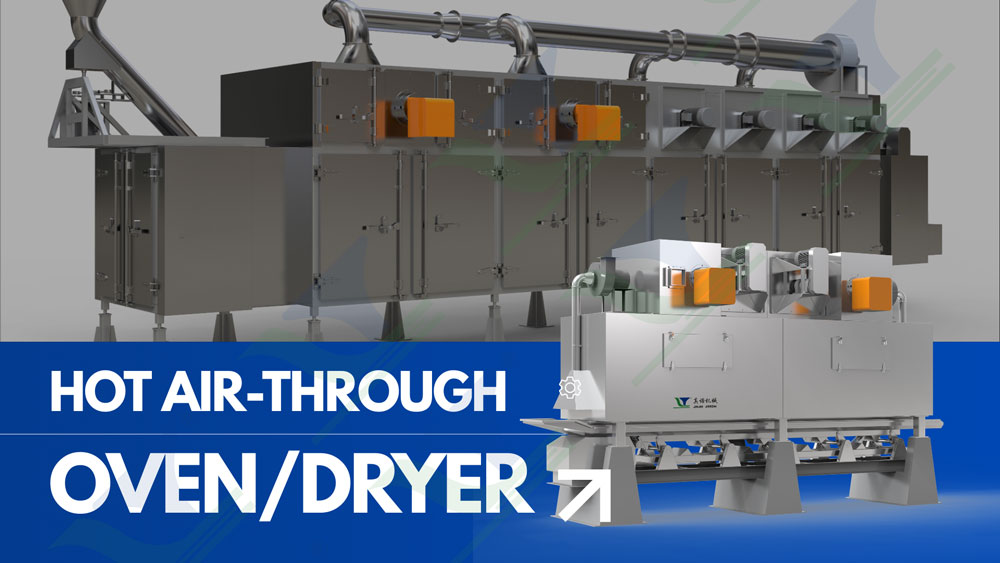
Chinese hot air oven/dryer manufacturers supply industrial drying systems that comply with CE certification and ISO standards. These systems feature multi-zone temperature control, energy-efficient hot air circulation (with recirculation rates of 70%–85%), and require 20%–40% lower initial investment compared to many Western suppliers. Widely used in grain, snack food, textured protein, and pet food production lines, these dryers enable industrial food processors to obtain globally compliant, high-quality equipment at highly competitive prices.
Drying technology is no longer just a supporting step in extrusion processing; it determines structural stability, final moisture resistance, shelf life, and operating costs. For serious B2B buyers, evaluating Chinese manufacturers requires attention to measurable engineering performance—not just price.
Industrial food processors commonly report:
• Final moisture deviations exceeding ±1–1.5%
• Energy consumption accounting for 20%–30% of total extrusion line operating costs
• Delivery times from Western suppliers exceeding 3–4 months
• Limited flexibility in customizing drying curves
In high-capacity plants (800–2000 kg/h), even slight drying inconsistencies can affect packaging efficiency and product uniformity.
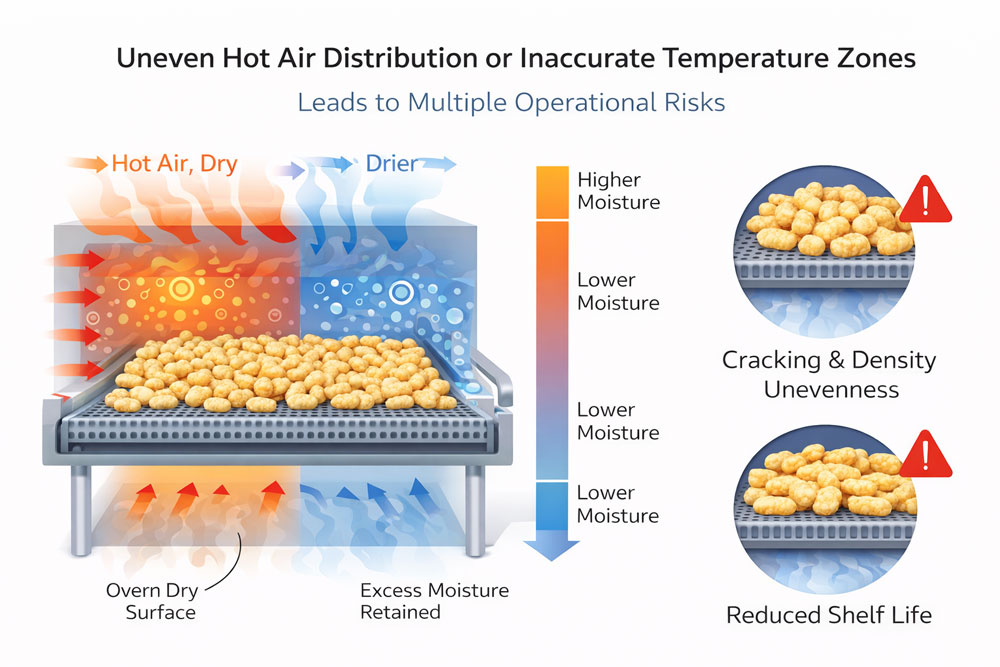
When airflow distribution is uneven or temperature zoning lacks precision, several operational risks emerge:
Moisture gradients develop between product layers. The surface may become over-dried while the core retains excess moisture. This leads to cracking, density inconsistencies, and shortened shelf life.
Energy waste also becomes significant. Poor insulation and low recirculation efficiency can increase annual fuel consumption by 10%–15%. Over an 8–10 year service life, these additional operating costs often exceed the initial equipment price difference.
For manufacturers running 20-hour continuous production schedules, such inefficiencies accumulate rapidly.
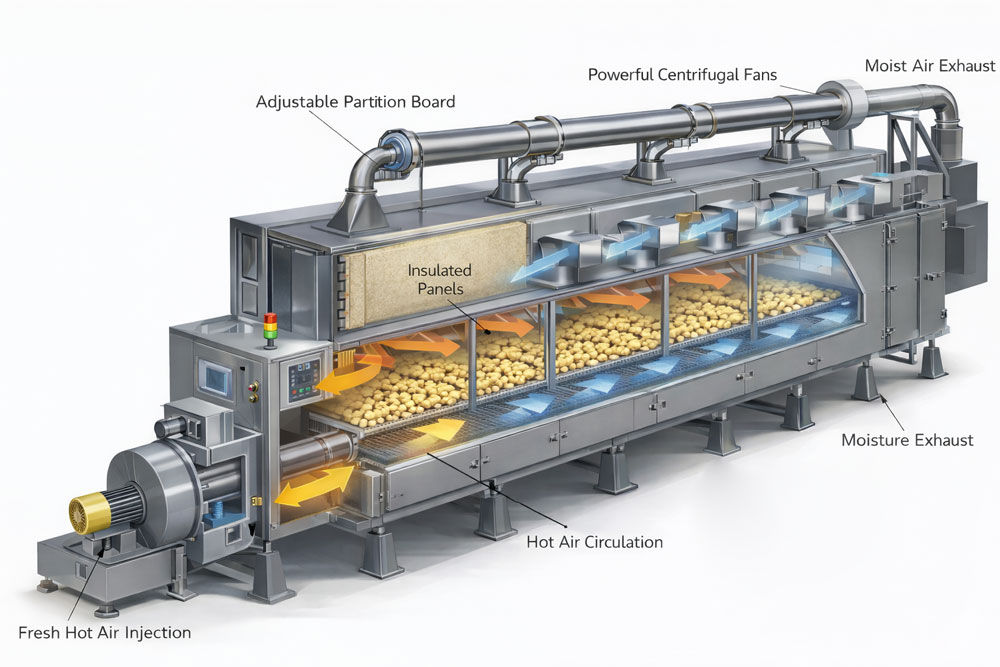
Over the past decade, leading Chinese hot air oven/dryer manufacturers have made substantial advancements in mechanical precision and thermal engineering design.
Typical current technical benchmarks include:
• 4–8 independent temperature zones
• PID temperature accuracy within ±1°C
• Hot air recirculation efficiency between 70% and 85%
• Double-layer insulated panels (50–100 mm thickness)
• Food-grade SUS304 or SUS316 materials
These specifications align closely with international industrial standards.
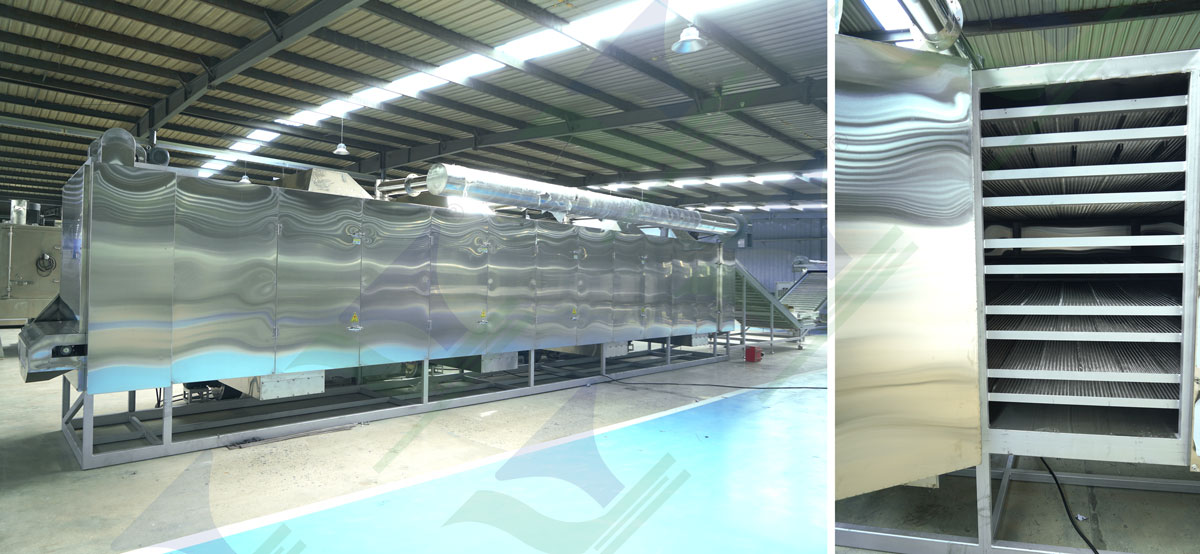
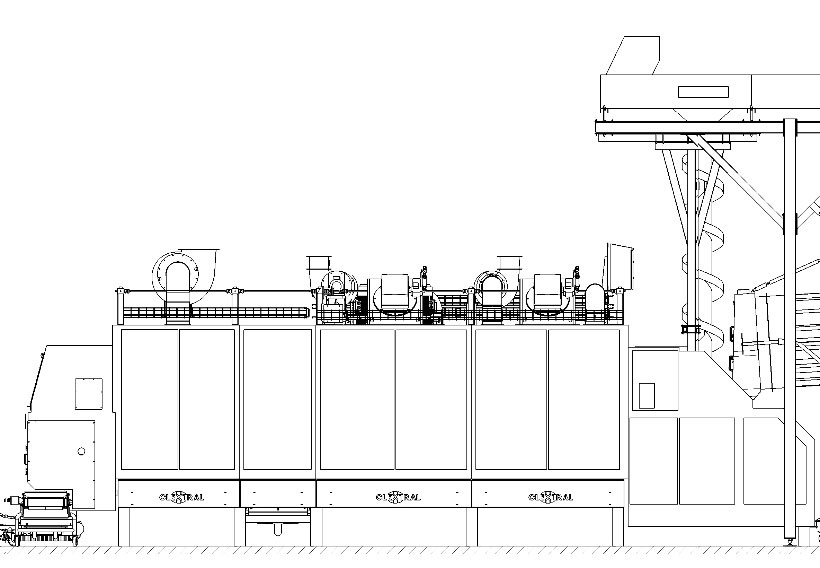
Industrial hot air dryers operate by forcing heated air through mesh belt layers, ensuring controlled moisture reduction during continuous production.
Below are reference specification ranges for medium-to-large capacity systems:
Parameter | Industrial Standard Range |
Production Capacity | 200–2000 kg/h |
Temperature Range | 50°C – 200°C |
Temperature Accuracy | ±1°C |
Moisture Reduction | 5–25% |
Drying Layers | 1–5 |
Heat Source | Gas / Electric / Steam |
Recirculation Efficiency | 70–85% |
In grain and snack applications, final moisture content is typically controlled within ±0.5% to 1%. This stability ensures consistent texture and reliable packaging performance.
Chinese manufacturers benefit from integrated supply chains and large-scale production capacity. Steel processing, electronic component sourcing, and mechanical fabrication are often concentrated within the same industrial clusters.
Compared to many Western suppliers:
• Initial equipment investment is typically 20%–40% lower
• Delivery cycles are usually shortened to 30–60 days
• Customized engineering modifications can be completed without lengthy approval procedures
Importantly, the cost advantage is not based on lowering material grades. Most reputable exporters use certified stainless steel and internationally recognized electrical components.
Energy performance has become a decisive evaluation factor.
Modern Chinese drying systems improve efficiency through:
• Optimized centrifugal circulation fan design
• Balanced airflow channel distribution
• Intelligent temperature zoning to prevent overheating
• High-density insulation panels to reduce heat loss
In continuous extrusion lines, improved airflow design can reduce annual fuel consumption by approximately 8%–15%.
For a production line operating 300 days per year with a capacity of 1000 kg/h, even moderate energy optimization can shorten the return-on-investment period to approximately 12–24 months.
Different food categories require customized drying curves.
Breakfast cereals require gradual moisture reduction to maintain their expanded structure and prevent surface cracking.
Textured soy protein requires staged dehydration to preserve fiber alignment and structural integrity.
Pet food processing typically targets final moisture content between 8% and 10%, with strict moisture control to ensure microbial stability.
Professional manufacturers conduct pre-production material testing and adjust:
• Belt speed frequency
• Airflow velocity
• Temperature gradient distribution
• Chamber length configuration
Customization capability directly impacts production success.
Industry requirements for equipment manufacturing standards and compliance continue to rise. Chinese hot air impingement oven/dryer manufacturers are accelerating upgrades in production systems, enhancing precision and stability through CNC machining, laser cutting, and automated welding processes. Complete machine load testing ensures reliable performance in continuous food production environments.
Most export-oriented manufacturers adhere to:
In terms of quality and compliance, most export enterprises have established ISO 9001 quality management systems and provide CE-certified technical documentation, complete engineering files, and operation and maintenance manuals in accordance with international market requirements. Equipment design increasingly emphasizes hygienic structure and cleanability to meet global food safety regulations. Through standardized manufacturing and compliance systems, Chinese manufacturers are gradually transforming from cost-driven suppliers to globally recognized providers balancing quality and standards.
When evaluating Chinese hot air oven/dryer manufacturers, procurement decisions should focus on measurable engineering indicators—not just price.
Key evaluation factors include:
• Temperature uniformity across zones
• Airflow distribution balance
• Insulation efficiency
• Material grade certification
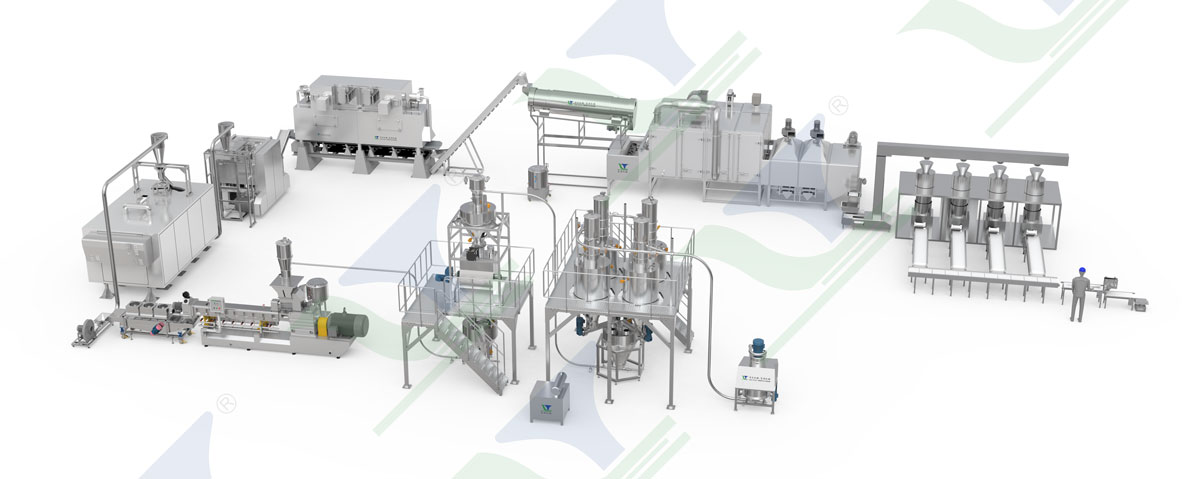
• Integration capability with upstream extruders
The most reliable suppliers position themselves as long-term technical partners rather than transactional equipment sellers.
The performance gap between Chinese and Western drying technology has narrowed significantly. Today, leading Chinese hot air oven/dryer manufacturers combine competitive pricing, advanced thermal engineering, CE certification, and scalable production integration capabilities.
For food producers seeking controlled investment risk and predictable operational performance, Chinese suppliers offer a balanced solution. The key lies in selecting a technically strong partner capable of delivering stable moisture control, energy efficiency, and long-term reliability.
What is the typical service life of a hot air dryer?
With proper maintenance, industrial systems typically operate for 8–12 years.
How precise is moisture control?
Advanced systems typically maintain final moisture tolerances within ±0.5–1%.
Are Chinese-made dryers suitable for the European market?
Yes, provided the manufacturer supplies CE-certified equipment and compliant electrical systems.
Can existing extrusion lines be upgraded with new drying systems?
Modular chamber designs enable integration with most mainstream extrusion systems.
If you are evaluating Chinese hot air oven/dryer manufacturers, focus on engineering precision, airflow efficiency, and long-term energy performance—not just initial price.
Jinan Arrow——Food Production Line Equipment Manufacturer
arrow@znmachinery.com
Contact our engineering team to obtain a customized drying solution tailored to your production capacity and product requirements.