

Views: 0 Author: Site Editor Publish Time: 2026-02-25 Origin: Site


When snack manufacturers expand the production scale of Kurkure, Cheetos, and Niknaks products, they often face issues such as low production efficiency and unstable product quality. As market demand grows, inefficient equipment quickly erodes profits and increases operational risks. The solution lies in selecting a high-efficiency Cheetos production line built to U.S. design standards, carefully engineered for stability, high automation, and doubled output capacity.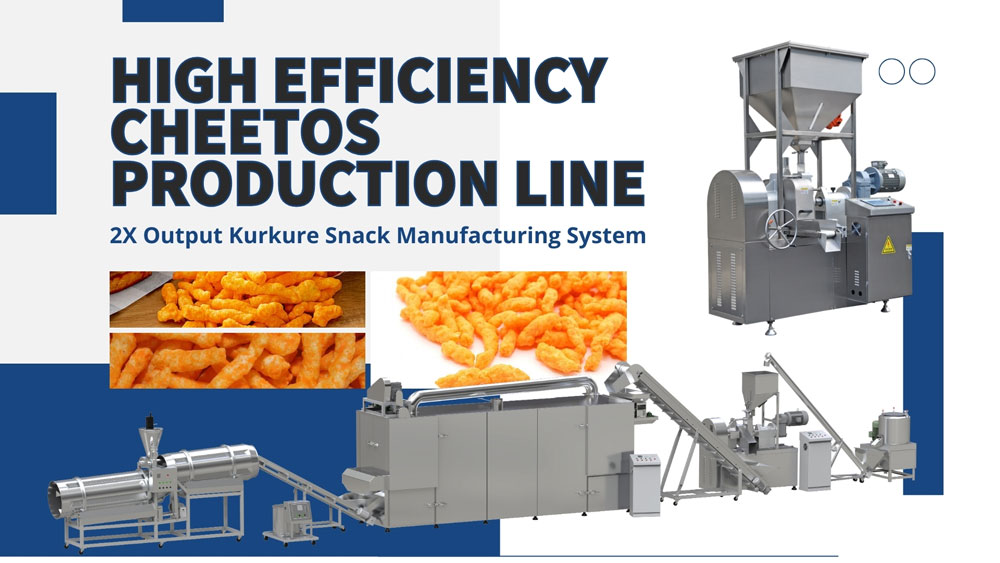
It can double output while reducing energy consumption and labor costs. By integrating twin-screw extrusion, rotary die forming, continuous frying, and automated seasoning systems, manufacturers can achieve stable texture, consistent expansion, and lower cost per kilogram. For snack producers seeking scalable, industrial-grade Kurkure or Niknaks production equipment, U.S.-standard structural engineering combined with competitive investment costs enables faster return on investment and long-term stable production.
If production efficiency determines profitability, then equipment structure determines sustainability. For manufacturers who truly value B2B snack production, this is not merely an equipment upgrade, but a strategic production decision that directly impacts cost control, expansion speed, and long-term competitiveness.
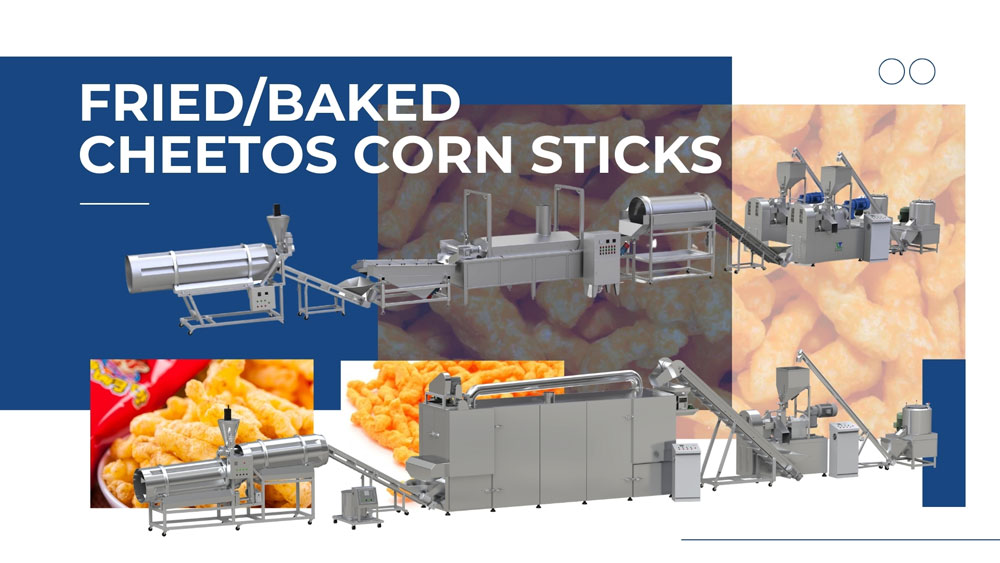
Many snack manufacturers entering or expanding in the Kurkure/Cheetos market encounter similar operational challenges:
• Production capacity cannot meet market demand
• High energy consumption per ton
• Frequent downtime due to mechanical instability
• Inconsistent product shape and texture
• Heavy reliance on manual adjustments
Traditional extrusion lines typically offer moderate capacity but fail to optimize material flow, screw configuration, and temperature control. As a result, production efficiency remains limited.
For buyers like Andy in the United States who value both quality and price competitiveness, such inefficiency will directly
In large-scale production of Kurkure, Cheetos, and Niknaks, the real challenge is not achieving high output once, but maintaining consistent product characteristics across continuous production cycles.
Industrial extrusion systems must synchronously control multiple parameters, including screw speed, feed rate, barrel temperature, and moisture content. In an optimized system, batch-to-batch deviations can be controlled within:
• Moisture deviation: ≤ ±0.5%
• Bulk density deviation: ≤ ±3%
• Product length tolerance: ≤ ±2 mm
• Oil absorption rate deviation: ≤ ±1.5%
Such repeatability ensures consistency in texture, expansion rate, and seasoning adhesion.
For manufacturers supplying retail chains or export markets, standardized product performance reduces customer loss caused by flavor variations and minimizes quality claims. Over time, process standardization also strengthens brand reliability and supply chain credibility. It directly impacts cost calculations and long-term scalability.
At first glance, a lower-priced production line may seem attractive. However, its hidden costs quickly become apparent:
Higher Cost Per Kilogram
If your equipment produces less per hour, fixed costs such as labor,electricity, and facility management are spread across fewer products.
Missed Market Opportunities
When production capacity cannot meet demand, competitors fill the gap. Retail shelf space is rarely forgiving.
Unstable Product Quality
Fluctuations in extrusion pressure or temperature lead to uneven expansion, poor texture, and higher defect rates.
Maintenance Interruptions
Poor structural design accelerates wear of gearboxes, bearings, and screws, leading to production interruptions and increased spare parts expenses.
Over time, seemingly minor efficiency gaps evolve into significant financial disadvantages.
In the highly competitive snack market, especially in North America, manufacturers must optimize output without sacrificing consistency.
Jinan Arrow has engineered its Kurkure Cheetos Niknaks production line to address these issues through structural optimization and intelligent integration.
Parameter | Standard Extrusion Line | Jinan Arrow Double-Efficiency Line |
Output Capacity | 150–200 kg/h | 300–400 kg/h |
Daily Output (8h) | 1.2–1.6 tons | 2.4–3.2 tons |
Energy Consumption | 180–220 kWh/ton | 120–150 kWh/ton |
Labor Requirement | 5–6 operators | 2–3 operators |
Automation Level | Semi-Automatic | Fully PLC Automated |
Downtime Frequency | Moderate | Low |
Expansion Stability | Variable | Highly Stable |
Production Efficiency | 100% (baseline) | 180–200% |
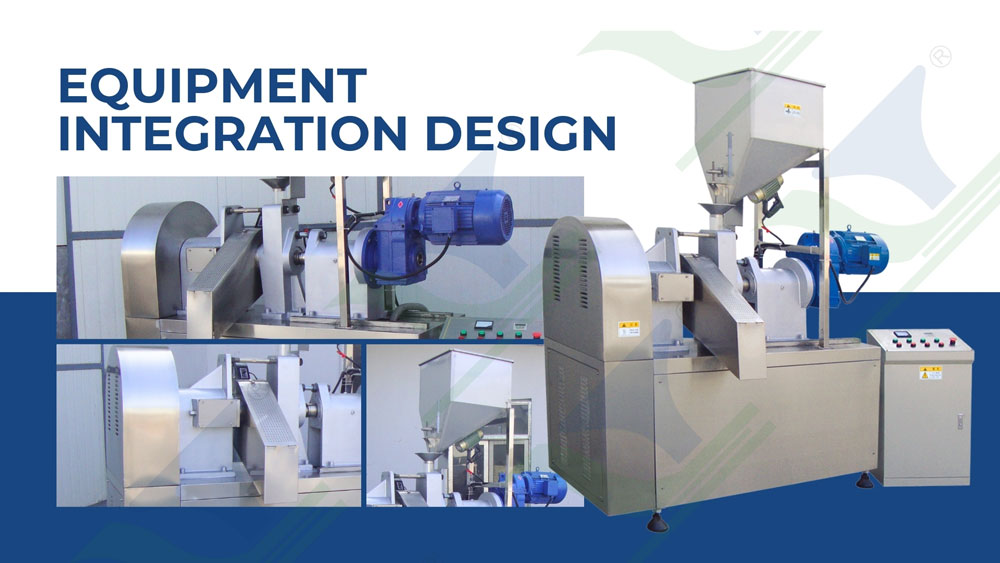
Our system integrates:
• High-torque twin-screw extruder
• Optimized screw element configuration
• Rotary die extrusion forming system
• Precision cutting unit
• Continuous frying or baking
• Intelligent drying system
• Automated seasoning and coating system
The entire production line operates under synchronized control to maximize output while maintaining product stability.
What “Double Efficiency” Means in Practice
Compared with many standard snack extrusion systems on the market:
• Hourly output is significantly increased
• Energy consumption per ton is reduced
• Manual labor requirements are minimized
• Structural durability reduces downtime
For manufacturers scaling up production, this means:
• Faster break-even period
• Improved gross margins
• Stronger pricing competitiveness
Many overseas buyers are cautious about sourcing equipment internationally. Compatibility, structural durability, and engineering standards are legitimate concerns.
Our Cheetos production line is developed under U.S. standard mechanical design principles, including:
Heavy-duty frame structure: A robust base frame ensures vibration control and long-term stability.
Modular layout: Each section—extrusion, frying, drying, seasoning—is independently designed for easy maintenance and future upgrades.
SUS304 food-grade materials: All contact parts comply with international food safety standards.
PLC + touchscreen control: User-friendly automation allows operators to monitor temperature, speed, and pressure in real time.
Maintenance-friendly design: Wear parts are easy to disassemble, reducing downtime during servicing.
This structural philosophy aligns with U.S. market expectations and integrates seamlessly into existing production facilities.
Our production line covers the entire workflow:
Raw material mixing – Twin-screw extrusion cooking – Rotary die forming – Continuous cutting – Frying or baking – De-oiling system – Seasoning and coating – Cooling and packaging interface
Each stage is designed for continuous industrial-scale production, not laboratory demonstration capability.
The extrusion process ensures:
• Uniform expansion
• Consistent internal structure
• Controlled moisture content
• Stable product density
These characteristics are essential for producing high-quality Cheetos-style snacks with uniform appearance and crispy texture.
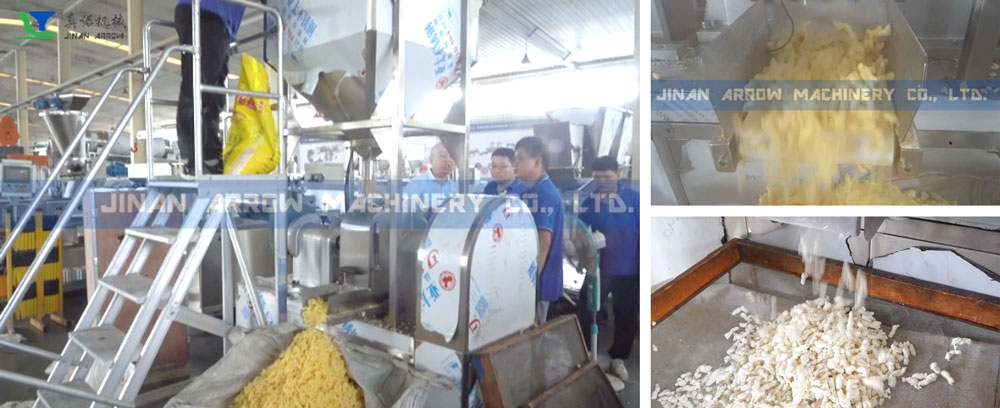
Efficiency is not achieved by speed alone, but through balance.
Optimized screw configuration: Stable material flow, even extrusion pressure distribution, and improved product consistency.
High-performance gearbox: Strong torque transmission ensures stable rotation under heavy-load conditions.
Intelligent temperature control: Precise heating zones enable consistent starch gelatinization and expansion.
Integrated automation: Reduced human error. Standardized production parameters.
Through these coordinated systems, production stability is enhanced and raw material waste is minimized.
For B2B decision-makers like Andy, purchasing equipment is not just about machinery—it is about calculating long-term production economics.
Our strengths include:
• 25,000 square meters of production facilities
• 120 skilled technical employees
• Export experience in 118 countries
• Multiple international certifications such as CE and ISO9001
• 18 utility model patents
This foundation ensures stable production quality and global delivery experience.
Compared with international brands, our Kurkure Cheetos Niknaks production line focuses on optimizing cost structure, achieving higher unit output and better energy efficiency under the same industrial standards, thereby reducing manufacturing cost per ton.
At the same time, we offer more competitive procurement solutions and more flexible delivery capabilities, enabling customers to achieve faster return on investment while ensuring performance.
Therefore, our competitive position is not based solely on price advantage, but on a more balanced and pragmatic solution across efficiency, stability, and cost control.
This combination allows manufacturers to expand capacity without excessive capital investment.
Our Cheetos production line can be configured according to:
• Required output capacity
• Factory layout space
• Energy supply specifications
• Product shape requirements
• Frying or baking preference
Customization ensures optimal performance aligned with your market positioning.
Whether you are launching a new snack brand or upgrading an existing factory, the production line can be designed accordingly.
An inefficient Cheetos production line quietly reduces profitability through hidden operating costs and capacity losses. For manufacturers aiming to scale in competitive markets, equipment must combine performance with structural reliability.
The Jinan Arrow Cheetos/Kurkure snack production line integrates U.S. standard design philosophy with intelligent automation, achieving doubled production efficiency and enhanced industrial durability, delivering competitive performance with optimized investment cost
For snack manufacturers, the right production line is not just about producing snacks—it enables sustainable growth.
Jinan ARROW — Food Production Line Manufacturer
arrow@znmachinery.com